
Digital Biofoundry
Accelerate strain engineering and bioprocess optimisation through predictive in silico modeling
Our digital biofoundry turns your target organisms and experimental data into mechanistic, predictive models of industrial bioprocesses. We design and test strain and pathway options in silico under real process constraints, helping you reduce R&D iterations, de-risk scale-up and unlock the full potential of your industrial biotech production pipeline.
Faster strain & pathway design
Lower R&D costs
Boost titer & yield
Stronger IP potential
91+
Curated GEMs
high-quality models
700+
Curated GEMs
standard-quality models
Up to 90%
High-accuracy
validated predictive models
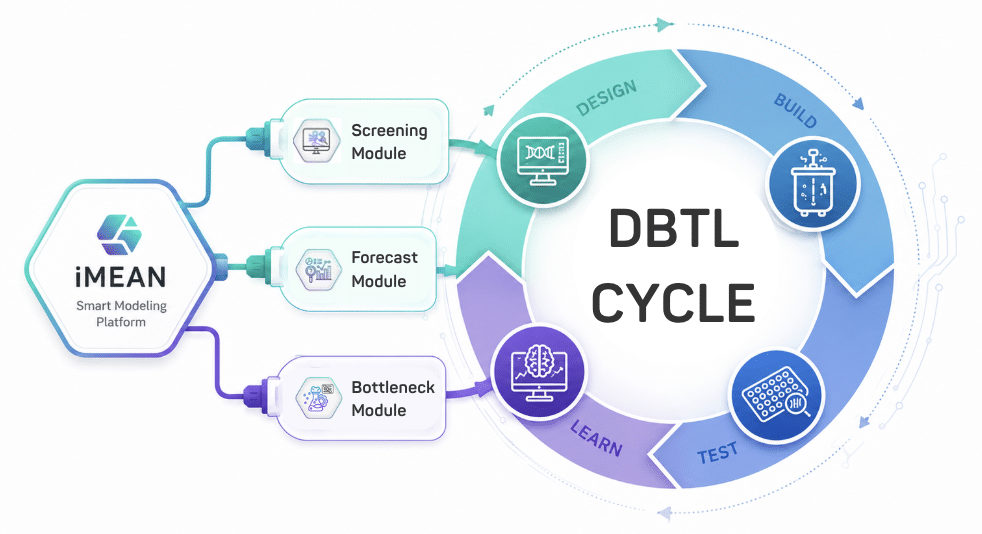
DBTL
Ready workflows
iterative improvement
Products & Services
Smart Modeling
Platform
Full-stack digital biofoundry built on iMEAN’s proprietary biochemical models database (Gaïa). We curate metabolic and signalling pathways into mechanistic digital organisms that plug directly into your DBTL cycles.
In silico
Bioanalysis
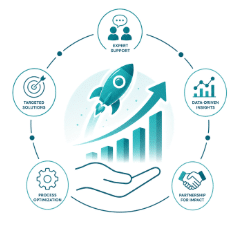
Expert service that combines iMEAN’s modelling, simulation and bioinformatics expertise into adaptive DBTL support, giving you flexible, end‑to‑end digital support, from early stage to full industrial process.
Digital Twin
Software
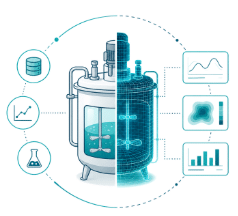
Virtual replica of your strain and bioprocess that enables in silico experimentation, design-space exploration and scale-up/tech-transfer scenario testing before running costly wet-lab campaigns.
CORE CAPABILITIES
How iMEAN help your team ?
From strain design to robust scale-up.
Explore our computational biology expertise through curated modeling, tailored platform and analytical services.
Organism & Pathway Design
Harness your organism’s metabolic potential
Exploring the possibilities of metabolic pathways, chasiss and bioprocesses is a major challenge in identifying the most promising synthetic organisms.
Our smart modeling platform delivers multi-layer models tailored to your bioprocess. Built on expert genome-scale reconstructions, it reveals metabolic, regulatory and biophysical limits before you spend months in the lab. We also provide a web-based exploration interface that allows project teams to navigate the full content of their models, including reactions, genes, metabolites and pathways.
We also perform in silico combinatorial studies that fit your bioprocess requirements and determine metabolic engineering strategies that ensure cellular homeostasis. Our design service alleviates competitive fluxes, generates new-to-nature pathways, delivers solutions robust to scale-up, and uncovers new patent opportunities.
Get a broad vision on innovative and patentable bioprocesses beyond preconceived solutions.
Microbial Consortia Design
Elucidate and engineer the interactions within your consortia
Understanding the complexity of metabolic interactions between multilple organisms represents a leap forward for industrial processes.
Microbial Consortia Design will model and reveal community interactions among natural producers and genetically modified organisms in mixed-culture fermentation system. Our advanced mechanistic models make it possible to control and optimise your consortia while narrowing the experimental design space and accelerating bioprocess development. We also developed a dedicated simulation software that helps your team predict how consortia and key bioprocess metrics evolve over time.
We also offer design service that mimics natural evolution in silico to explore how strains may adapt under process-relevant conditions, predict experiment duration and expected evolutionary trajectories, allowing you to develop an optimal bioprocess.
We provide the means to leverage and orientate the potential of your consortia.
Feasibility & risk assessment
An in silico crash-test of your project
Biotechnology projects are notoriously expensive, time consuming, and prone to failure.
For clients who are still defining the right strain or molecule candidate to pursue, we also offer an opportunity study combining scientific review, cost metrics and IP landscape analysis to prioritise the most promising option.
The feasibility study remove risks from your project by testing it using industrial scenarios and by evaluating its expected performances. It identifies the main bottlenecks you will encounter and measures the difficulties you may have to overcome. It is particularly relevant in assessing you competitive edge.
Make data-driven decisions with a concrete vision on what you can expect from your projects.
Powered by iMEAN
Custom Data Analyses
Your data is a gold mine, we extract the maximum of its worth
Whenever the organism you are working on, we offer custom analyses of experimental, historical and multi-omics datasets, helping you extract actionable insight for pathway identification, protein design or process optimization.
We can build tailored databases and develop custom-made software applications, with the possibility of a web interface to store, manage, visualise and/or analyse your metadata.
In addition, we offer a large range of Bioinformatics services, providing high-quality and expertise to help you advance your R&D needs. It includes Genome Assembly and Annotation, Transcriptomics Analysis, Multi-omics Analysis and Exploration, and Genome-Wide Association Studies (GWAS) Analysis.
Bioprocess Optimisation
Empower your process development with our expert services
Scaling bioprocesses from lab to industrial scale is often limited by unstable performance, length optimisation cycles and costly trial-and-error experimentation.
We offer services to engineer robust processes under industrial conditions and optimise bioprocess operation cross batch, fed-batch and continuous modes. This expertise is available through two modules:
1) Digital Boost – a continuous one-year support integrated into your DBTL cycles.
2) Digital Sprint – an one-shot service for targeted projects.
In addition, we also develop a simulation software for your bioprocess, allowing you to compare multiple in silico scenarios before going to the lab.
For projects that require both modelling and experimentation, our team can partner with upstream and downstream processing experts to support your work without expanding your internal infrastructure.
Digital Twin
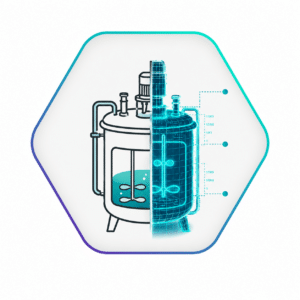
From deviation detection to advanced process control
Industrial biotechnology workflows are increasingly complex, while experimental iteration remains time-consuming and costly. To truly overcome these constraints, it is not enough to optimise individual steps – you need smart automation that continuously learns from your data.
We offer Digital Twin that connects directly to your existing automation workflows, creating a continously evolving predictive environment that pinpoints bottlenecks, suggests adaptive next steps and accelerates upstream bioprocess development through real-time, remote bioreactor monitoring. We can adapt the Digital Twin to any new type of equipment and ensure a smooth plug-in to your infrastructure and workflows.
INDUSTRIAL APPLICATIONS
Where can iMEAN help you innovate?
Our solutions suport every stage of industrial bioprocess development, from strain design to scale-up and performance optimization.

Strain design and optimization

Pathway and target molecule strategy

Media, feeding, and
operating-condition optimization
Fermentation scale-up and robustness assessment
Business impact
> 600k€
6 months
x2.8
R&D budget saved
R&D budget saved
R&D time saved
*Results shown are from a single case study and may vary across projects.
Why Choose iMEAN?

Custom Digital Organisms
For Your Biology
Tailor‐made in silico models that capture the complexity of your organism and deliver high‐confidence predictions for your R&D decisions.

High-quality Models,
Delivered Fast by Experts
We combine mechanistic modelling with expert manual curation to turn your data into well validated models, so your projects move from data to decisions much faster.

Your Digital Partner
From Cell To Product
We team up with you and our partners to link strain design, upstream and downstream with digital twin – so you can optimise end‐to‐end bioprocesses before costly lab work
FAQs
What’s an SBML file ? How can we use it ?
An SBML (Systems Biology Markup Language) file is an XML-based format for representing computational models in systems biology. It is a standardized way to exchange and share stored models of biological processes, particularly those related to cellular and molecular biology, such as metabolic networks, signal transduction pathways, and gene regulatory networks.
There are various software tools and libraries available for creating, editing, simulating, and analyzing SBML models, such as COPASI and CellDesigner. You can also choose to use iMEAN’s Network Explorer Platform.
How Accurate are the Predictions from iMEAN’s Genome-Scale Metabolic Models?
Even though the accuracy of the predictions will depend on the data quality and model complexity, we’ve conducted various comparison of data generated by our predictive models and the data measured in real wet lab experiments, we’ve been able to evaluate a prediction accuracy of our High-Quality models being around 90%.
Our Data are Incomplete or Heterogeneous, can we still work with iMEAN?
Yes. Many projects start from incomplete or heterogeneous datasets, and our workflows are designed to handle exactly that situation. However, we do require a minimum level of data, typically at least a sequenced genome (partial or complete) for the strain(s) of interest, so that we can build a consistent and biologically grounded model.
We first assess the data you already have, identify the most critical gaps for modelling, and then focus on standardising and cleaning the information that can be reliably reused. Where appropriate, additional information can also be sourced from the literature or predicted using our deep learning algorithms (AI), so that you do not need to generate everything experimentally from scratch. Our modelers also verify the accuracy and biological consistency of key data inputs (e.g. genes, enzymes, metabolites and their interactions in biochemical pathways), to ensure that models are built on a robust foundation.
Can iMEAN also organise the Experimental work, or do we need to run all Wet‑lab activities ourselves?
For projects that require both modelling and experiments, iMEAN can team up with our wet‐lab partners– including upstream and downstream processing experts – to design and execute targeted experiments, generate the missing data, and iterate DBTL cycles, without requiring additional internal lab capacity on your side.
We do not have In‑house expertise in Modelling and In‑silico tools. Does iMEAN provide Training?
Yes. We can organise tailored, fee‐based training sessions that combine a concise theoretical refresher with hands‐on exercises on your own use cases, so that your team can confidently reuse and adapt the delivered models and tools.